China is the world’s most populous country with the second-leading economy. Chinese economic growth over the past decades has been nothing short of staggering. Meanwhile, investors have stayed clear of Chinese investments as the relationship between Washington and Beijing has deteriorated.
In bear markets, investors have limited choices, but many turn to assets with significant value, hoping they will outperform the overall market. In November 2022, Chinese stocks attracted buying, and sentiment has turned moderately bullish. The iShares China Large-Cap ETF product (FXI) owns Alibaba (BABA) shares and other Chinese equities that trade on Hong Kong and other international stock exchanges.
FXI has underperformed the S&P 500 in 2022
The S&P 500 index is the most diversified US stock market indicator.

The chart shows at 4,026.12, the leading stock market index was 15.5% lower than the December 31, 2021, closing level. Meanwhile, the leading large-cap Chinese stocks have done a lot worse in 2022.

The FXI chart shows the move from $36.58 on December 31, 2021, to the $25.33 level on November 25, a 30.8% decline.
A recovery since the October 31 low.
Rising interest rates have weighed on stocks in 2022. The bearish price action in stocks is causing many investors to search for value to take advantage of the most significant decline in equity prices since early 2020, when the global pandemic gripped markets across all asset classes and sent prices lower. Over the past weeks, Chinese stocks recovered as the sentiment shifted, sending the FXI ETF higher.
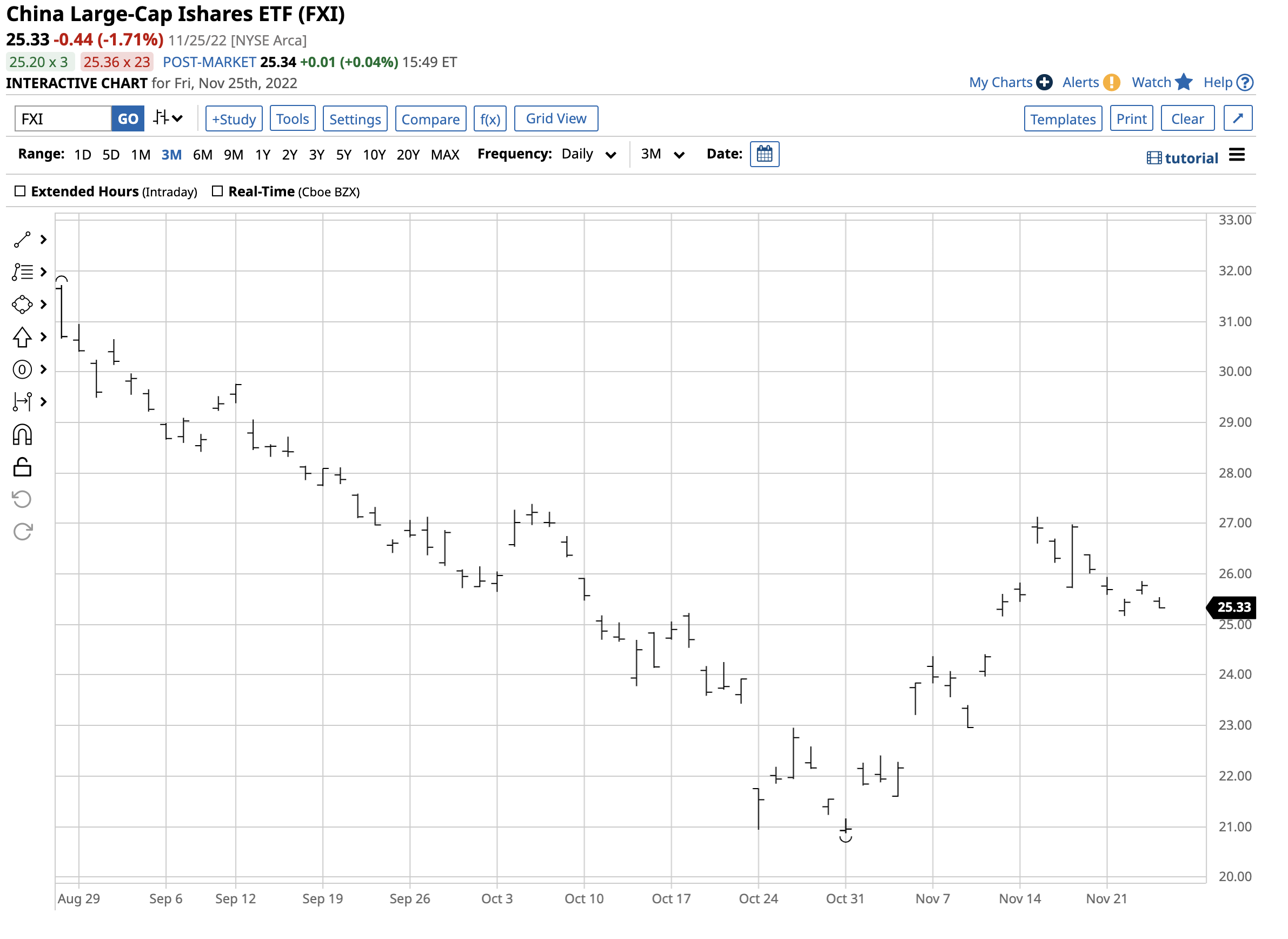
The short-term chart illustrates the rally that took the FXI from a $20.95 low on October 31 to the $25.48 level on November 25, a 21.6% gain. The ETF traded to a high of $26.60 on November 15 and was closer to the recent peak than the late October low, which was the FXI’s lowest level since November 2008.
The top holdings offer value- Charley Munger has loved BABA, but BABA has not returned the favor
The top holding of the FXI ETF is Alibaba Group (BABA). As of November 25, the ETF held nearly 9% of its assets in the Chinese e-commerce giant. At $25.33 per share, FXI had $4.5 billion in assets under management. The ETF trades an average of more than 45 million shares daily and charges a 0.74% management fee.
One of BABA’s leading supporters has been value-investor Charley Munger. Warren Buffet’s partner held 300,000 BABA shares as of September 30, 2022, representing 14.68% of his portfolio. In April 2022, Mr. Munger spoke about his investments in China, saying, “They have their own culture and their loyalties, and the reason I invested in China is they have much better companies at lower prices, so it’s worth taking the risk.” While he has not done well with his BABA investment, the position as of the end of 3 2022 is a sign that he continues to favor BABA and the value proposition for Chinese stocks. After the late October low, other market participants have decided that Chinese stocks are “worth taking the risk.”
The bullish case for FXI
The following factors are bullish for FXI:
- The price/earnings ratio for the SPY is at the 16.41 level as of November 25. The metric for the FXI stood at 9.27.
- The blended dividend yield for the SPY was 1.54%, while the FXI’s was higher at 2.29%.
- At the recent G-20 summit, there appeared to be a warming of relations between President Biden and President Xi, which likely led to buying in Chinese stocks.
- China will eventually emerge from the COVID-19 lockdowns that have weighed on its economy. The end of lockdowns could cause a sudden and substantial rally in the FXI, which has been under pressure for years.
The FXI offers value, but the potential for rewards is always a function of the risks.
The bearish case for the large-cap Chinese ETF product
Investors have shunned Chinese stocks since 2008. Over the past fourteen years, the FXI has moved from a low of $19.35 to the $25.33 level, a 30.9% gain. Meanwhile, the SPY ETF that tracks the S&P 500 advanced from $67.10 to $402.33 per share over the period, a 499.6% gain. The bearish case for Chinese stocks includes:
- Transparency issues with Chinese stocks that trade on the Hong Kong Exchange and other worldwide stock exchanges.
- China’s February 2022 “no-limits” alliance with Russia was a prelude to Russia’s invasion of Ukraine.
- China’s demands for reunification with Taiwan.
- Deteriorating relations between Beijing and Washington, DC, over the past years.
- The bearish trend of underperformance of the Chinese stock market compared to US equity prices.
China’s value proposition comes with more than a few risks, but as the world’s second-leading economy, the US market is critical for China’s future economic growth. Risk-reward favors Chinese stocks and the FXI ETF at the current level, and value seekers like Charley Munger believe they are “worth the risk.”
The FXI offers value compared to the SPY and the S&P 500, but the risk is always a function of the potential for rewards.
More Stock Market News from Barchart
- Nvidia Out-of-the-Money Puts and Calls Are Attracting Income Buyers
- Here’s One Hot Stock That Could Fundamentally Rise Even Higher
- Stocks Settle Mixed in Holiday-Shortened Session
- Bear Markets Rarely Move In Straight Lines

/Super%20Micro%20Computer%20Inc%20logo%20on%20building-by%20Poetra_RH%20via%20Shutterstock.jpg)