





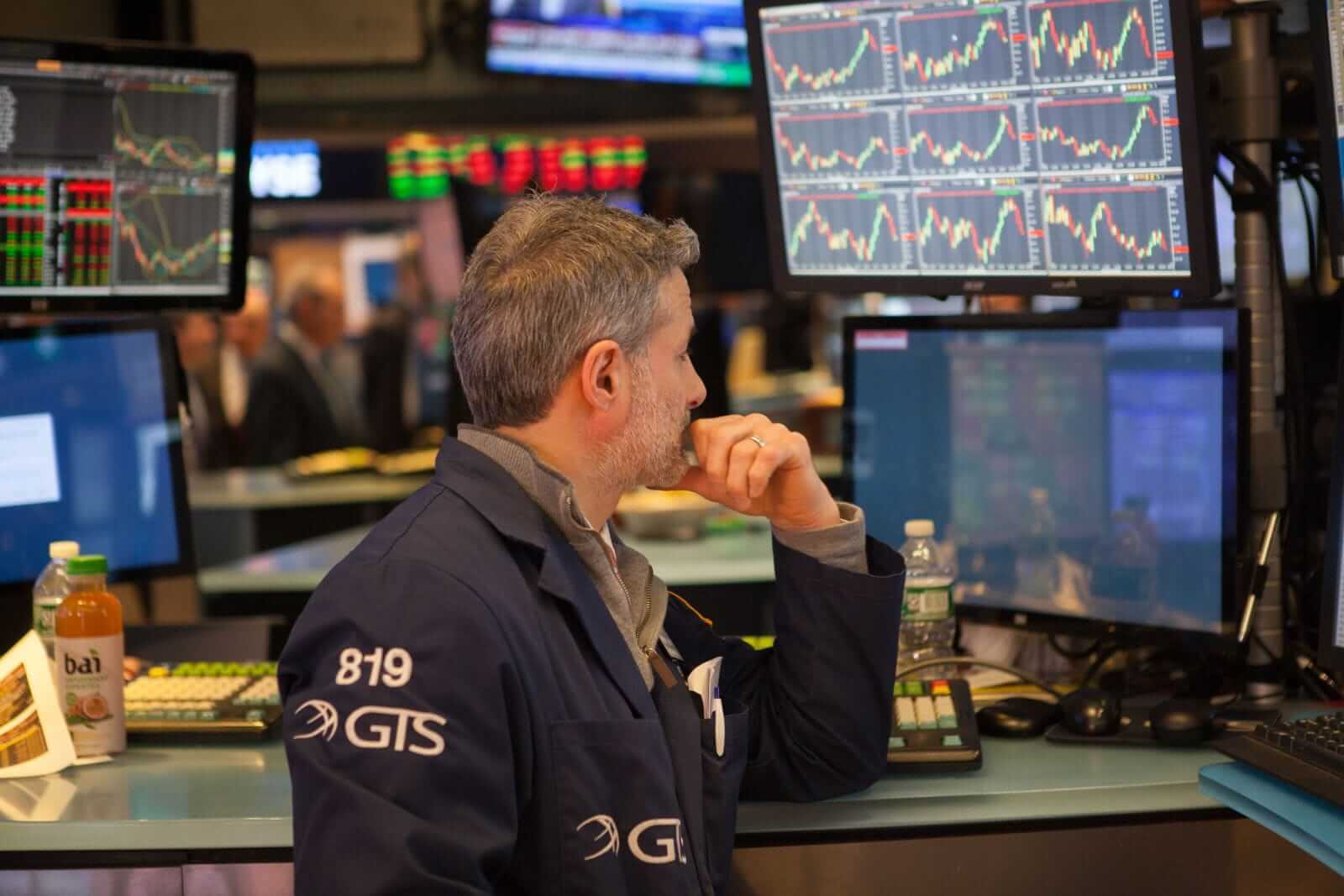
September S&P 500 E-Mini futures (ESU26) are down -0.23%, and September Nasdaq 100 E-Mini futures (NQU26) are down -0.17% this morning, pointing to a lower open on Wall Street as renewed hostilities in the Middle East pushed oil prices higher.
The price of WTI crude climbed nearly +4% on Monday after the U.S. and Iran exchanged strikes for the first time in about a month. U.S. forces struck two Iranian rocket launchers on Sunday that Central Command said were being prepared to deploy mines into the Strait of Hormuz. In response, Iran’s Islamic Revolutionary Guard Corps carried out a missile-and-drone strike on U.S. air bases in Jordan early Monday. Separately, the IRGC said that an unidentified supertanker attempting to transit the southern route through the Strait of Hormuz was hit by two mines. Meanwhile, U.S. President Donald Trump posted an AI-generated video depicting Iran’s Kharg Island being blown up, hours after the U.S. strike.
Treasuries were mixed on Monday. Yields on shorter-dated Treasuries fell, paring some of Friday’s jump following Federal Reserve Chairman Kevin Warsh’s hawkish speech, while yields on longer-dated notes rose as higher oil prices fueled inflation concerns.
This week, market participants are looking ahead to a slew of U.S. labor market data and earnings reports from several high-profile tech companies.
In Friday’s trading session, Wall Street’s major equity averages closed lower. Chip and AI infrastructure stocks sank, led lower by a more than -10% slump in Marvell Technology (MRVL) after the chip designer delivered only a modest Q2 beat and provided slightly higher-than-expected Q3 guidance, leaving investors disappointed. Also, PayPal Holdings (PYPL) tumbled over -12% and was the top percentage loser on the S&P 500 and Nasdaq 100 after Bloomberg reported that a consortium including payments company Stripe and private-equity firm Advent had abandoned its pursuit of the company. In addition, IREN Limited (IREN) plunged more than -12% after the company reported weaker-than-expected FQ4 adjusted EBITDA. On the bullish side, Workday (WDAY) climbed over +5% and was the top percentage gainer on the S&P 500 and Nasdaq 100 after the software company reported better-than-expected Q2 results and raised the lower end of its full-year subscription revenue guidance.
Economic data released on Friday showed that the University of Michigan’s U.S. August consumer sentiment index was revised upward to 51.7, stronger than expectations of no change at 51.0. At the same time, the U.S. Chicago PMI unexpectedly sank to 47.1 in August, weaker than expectations of 57.9. In addition, the Bureau of Labor Statistics preliminarily revised its estimate of total nonfarm employment in the year through March down by 0.1%, or 79K jobs.
Fed Chairman Kevin Warsh said at the central bank’s annual conference in Jackson Hole, Wyoming, on Friday that inflation is not slowing meaningfully and warned that policymakers must be confident it is; otherwise, the central bank still has “work to do.” Mr. Warsh reaffirmed that policymakers will bring inflation back to their 2% goal, which he described as a firm and fixed target. He added that financial conditions are not currently restrictive and that interest rates remain the Fed’s “predominant tool” for achieving its mandate.
Market participants interpreted Warsh’s Jackson Hole speech as a signal that the Fed could raise interest rates next month to rein in price growth. The odds of a 25-basis-point rate hike at the September FOMC meeting currently stand at 61.9%, up from 35% right before the speech.
“Warsh’s comments boosted rate-hike odds and terminal-rate pricing, though markets may have overreacted given the Fed’s September decision remains highly dependent on upcoming payrolls and inflation data,” said Oscar Munoz at TD Securities.
The U.S. August Nonfarm Payrolls report will be the main highlight this week, as investors gauge the health of the economy and the likely timing of the Fed’s interest-rate hike. Economists expect the key jobs report to show the unemployment rate holding steady at 4.1% while payrolls increase by 58K following an unexpected decline in July. Such a headline figure would be broadly consistent with the average pace of job growth this year. Other labor market data to watch include JOLTS Job Openings, ADP Nonfarm Employment Change, and Initial Jobless Claims. Investors will also keep a close eye on the Institute for Supply Management’s August manufacturing and services surveys, particularly the prices-paid sub-indices for fresh clues on inflation.
Market watchers will also focus on earnings reports from several high-profile companies. Chip designer Broadcom (AVGO), cybersecurity firm Palo Alto Networks (PANW), server maker Dell Technologies (DELL), and other notable companies including Snowflake (SNOW), Hewlett Packard Enterprise (HPE), MongoDB (MDB), and Ciena (CIEN) are scheduled to report their quarterly results this week.
In addition, the Fed will release its Beige Book survey of regional business contacts this week, providing anecdotal insight into economic conditions across the country. The Beige Book is published two weeks before each meeting of the policy-setting Federal Open Market Committee. Market participants will also parse comments from Fed Governors Christopher Waller and Michael Barr this week.
Elsewhere, John Ternus will succeed Tim Cook as Apple (AAPL) CEO on Tuesday, while Tesla (TSLA) will host an invite-only Cybercab launch event on Thursday in Austin.
The U.S. economic data slate is largely empty on Monday.
In the bond market, the yield on the benchmark 10-year U.S. Treasury note is at 4.73%, up +0.19%.
The Euro Stoxx 50 Index is down -0.24% this morning as renewed military escalation between the U.S. and Iran drove oil prices and bond yields higher, sapping risk appetite. Technology, real estate, and industrial stocks underperformed on Monday. At the same time, energy stocks advanced, tracking a rise in oil prices. Eurozone government bond yields climbed on Monday, with the 10-year Bund yield reaching a fresh 15-year high, as rising oil prices fueled inflation concerns. Investor attention this week is centered on the Eurozone’s preliminary inflation data for August. Economists expect the Eurozone’s August CPI to accelerate to +3.3% y/y from +2.9% y/y in July, adding pressure on European Central Bank officials to raise rates again. The Eurozone’s final PMIs for August and the July unemployment rate will also draw attention. In addition, several appearances by ECB policymakers are scheduled before they enter a pre-decision quiet period on Wednesday ahead of their meeting the following week. In corporate news, OHB (OHB.D.DX) climbed over +6% after the satellite maker secured a contract worth nearly 1 billion euros ($1.2 billion) to develop and manufacture 18 satellites for the European Union’s IRIS2 secure communications program.
Asian stock markets today settled mixed. China’s Shanghai Composite Index (SHCOMP) closed up +0.86%, and Japan’s Nikkei 225 Stock Index (NIK) closed down -0.14%.
China’s Shanghai Composite Index reversed earlier losses and closed higher today as a late surge in tech shares outweighed concerns about weak PMI data and a selloff in property stocks. Technology stocks rallied in the afternoon session on Monday, helping lift the benchmark index into positive territory. Bank stocks also climbed after the country’s largest lenders posted their strongest first-half profit since the peak of the property crisis. Limiting gains, property stocks plunged after the government unveiled regulatory changes aimed at restoring confidence in the crisis-hit sector, though the measures fueled expectations for further consolidation across the industry. Meanwhile, a survey from the National Bureau of Statistics released on Monday showed that China’s factory activity improved more than expected in August on stronger demand, although it remained in contraction for a second straight month. China’s August non-manufacturing PMI, which covers both services and construction activity, was unchanged from July’s reading, the weakest since December 2022. Investor attention now shifts to China’s private gauges of manufacturing and services activity for August, which will round out the PMI picture. In corporate news, Sungrow Power Supply slid over -6% after the inverter and energy storage giant posted a steep decline in first-half profit.
The Chinese August Manufacturing PMI came in at 49.8, stronger than expectations of 49.5.
The Chinese August Non-Manufacturing PMI arrived at 49.0, weaker than expectations of 49.5.
Japan’s Nikkei 225 Stock Index closed slightly lower today as investors weighed escalating tensions in the Middle East and hawkish remarks from Fed Chairman Kevin Warsh. The Nikkei initially fell as much as 2.37% as chip-related stocks tumbled following Friday’s losses in their U.S. peers. However, the benchmark index trimmed most of its losses in the afternoon session, tracking a rebound in regional peers and U.S. equity futures. Maki Sawada at Nomura Securities noted that the Nikkei began to recover after briefly falling below the 65,000 mark, which is viewed as a “key support level.” Government data released on Monday showed that Japan’s monthly industrial production rose in July for a fourth straight month, indicating that manufacturers proved more resilient than expected amid uncertainty stemming from the Middle East conflict. Separate data provided an encouraging signal on consumption, as annual retail sales rose more than expected in July. Taken together, Monday’s data point to resilience in the Japanese economy that will keep the Bank of Japan on course for a near-term rate hike. Meanwhile, the two-year Japanese government bond yield climbed to a 31-year high on Monday amid growing expectations of BOJ rate hikes and uncertainty surrounding debt auctions later in the week. In corporate news, Zeon Corp. rose over +4% after Nomura upgraded the stock to Buy from Neutral. Investor focus now turns to Japan’s final August PMIs and July household spending figures. Market participants will also closely watch a speech from BOJ policy board member Hajime Takata, one of the BOJ’s most hawkish officials. The Nikkei Volatility Index, which takes into account the implied volatility of Nikkei 225 options, closed up +19.70% to 27.83.
The Japanese July Industrial Production (preliminary) unexpectedly rose +0.1% m/m, stronger than expectations of -0.7% m/m.
The Japanese July Retail Sales rose +4.0% y/y, stronger than expectations of +3.2% y/y.
Pre-Market U.S. Stock Movers
PG&E Corp. (PCG) tumbled over -11% in pre-market trading after the California Senate agreed on a bill that would make utility companies liable for more wildfire-related costs.
Software stocks slid in pre-market trading, with ServiceNow (NOW) and Palantir Technologies (PLTR) falling over -1%.
Some chip and AI infrastructure stocks edged higher in pre-market trading, recovering some of Friday’s losses. Lam Research (LRCX) was up over +1%, Intel (INTC) was up about +0.8%, and ON Semiconductor (ON) was up about +0.7%.
Energy stocks advanced in pre-market trading as oil prices climbed. Chevron (CVX), ConocoPhillips (COP), and Occidental Petroleum (OXY) were up over +1%.
Deere & Company (DE) gained more than +1% in pre-market trading after Baird upgraded the stock to Outperform from Neutral with a price target of $800.
You can see more pre-market stock movers here
Today’s U.S. Earnings Spotlight: Monday - August 31st
Science Applications International (SAIC), Apnimed (APMD), Apartment Investment and Management Company (AIV).
On the date of publication, Oleksandr Pylypenko did not have (either directly or indirectly) positions in any of the securities mentioned in this article. All information and data in this article is solely for informational purposes. For more information please view the Barchart Disclosure Policy here.

/A%20Palantir%20office%20building%20in%20Tokyo_%20Image%20by%20Hiroshi-Mori-Stock%20via%20Shutterstock_.jpg)
/Elon%20Musk%2C%20founder%2C%20CEO%2C%20and%20chief%20engineer%20of%20SpaceX%2C%20CEO%20of%20Tesla%20by%20Frederic%20Legrand%20-%20COMEO%20via%20Shutterstock.jpg)
/Microsoft%20sign%20at%20the%20headquarters%20by%20VDB%20Photos%20via%20Shutterstock.jpg)
/Apple%20Inc%20logo%20on%20Apple%20store-by%20PhillDanze%20via%20iStock.jpg)